Starlight Biotech
Sperans ad adstra
With inspiration and diligence, reach for the stars… We are on an exciting journey, a journey to humanity’s future… Starlight Biotech strives to create ideas and products placing it at the forefront of that journey.
Somewhere, something incredible is waiting to be discovered…
Sharon Begley, on Carl Sagan’s passion for discovery.
We explore and pose questions…
We come up with pertinent questions to ask, based on current knowledge about a particular topic.

Find patterns
We also discover interesting patterns in data, anomalies and fresh avenues of investigation.

Research
We formulate hypotheses to explain the anomalies or answer the questions we pose. We make predictions based on the hypotheses, and test the predictions using bioinformatics / computational biology and if needed, lab experiments.

Draw conclusions
We draw conclusions, based on our findings, and come up with new hypotheses, based on the results. We then iterate.

We are working on research projects…
From our blog
-
The marvel that is Alphafold, a revolutionary new tool for drug discovery
By Noreen Brenner, CEO and CSO
March 8, 2024
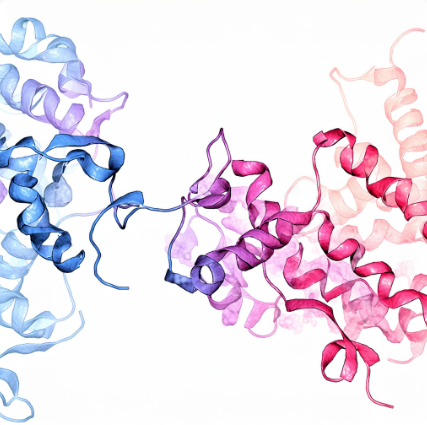
Image attribution: Based on Emw, CC BY-SA 3.0 https://creativecommons.org/licenses/by-sa/3.0, via Wikimedia Commons, altered by Firefly AI
For sixty years, scientists tried to predict protein structure based on protein sequence. This seemed an impossible task, until Google’s Alphafold, an AI, achieved the impossible last year.
From 1994 until 2023, scientists participated every two years in the Critical Assessment of Techniques for Protein Structure Prediction (CASP) competition. CASP’s task was to predict protein structure based on amino acid sequence, without knowing the experimentally determined structure. In September 2023, Alphafold far surpassed all other participants in very accurately predicting protein structure, and not only won the competition but achieved a Holy Grail of biological science.
How did Alphafold manage to win? It used deep learning machine learning algorithms, and was trained on innumerable known protein sequences matched to their known structures (available in the Protein Data Bank or PDB).
Alphafold’s great feat of cracking the code of how amino acid sequences fold to form 3-dimensional protein structures will facilitate drug discovery, as it is a useful tool in identifying targets.
References:
- 60 Years in the Making: AlphaFold’s Historical Breakthrough in Protein Structure Prediction | From Atoms To Words (arturorobertazzi.it)
- CASP14: what Google DeepMind’s AlphaFold 2 really achieved, and what it means for protein folding, biology and bioinformatics | Oxford Protein Informatics Group (blopig.com)
- How DeepMind’s protein-folding breakthrough could transform drug development (thenextweb.com)
 Starlight Biotech